Choice of Law Matters
Choice of Law
✳︎
Favorable Jurisdiction
✳︎
Dynasty
✳︎
Choice of Law ✳︎ Favorable Jurisdiction ✳︎ Dynasty ✳︎
You may be thinking to yourself “…but didn’t you say we should want to operate in a non-statutory realm?...why should statutory rules and codes apply to my Private Trust?”
Great thinking…but, we still like to plan for “best practices” in a “worst-case” scenario.
Even though the public (anyone outside of the Trust) is unable to challenge a Private Trust - in any Trust, there is always the concern for an internal dispute that can go awry (i.e. bad faith actor Beneficiary who believes they are entitled to something in the Trust that goes against the Grantor’s expressed wishes, then drags it into court). In this “worst case scenario”, Equity Jurisprudence would be our first line of defense. Choosing a favorable Trust state, is liken to getting to choose the cards you are dealt. Why wouldn’t you want the best cards possible? Even if a Private Trust gets “pulled into the public”, Wyoming is a state that has greater Privacy protective perimeters in place than almost any other state (such as Delaware).
If you can lawfully choose to house your Trust in a state that has no state income, estate, gift or capital gains tax, why wouldn’t you? The list of “Pros” is long.
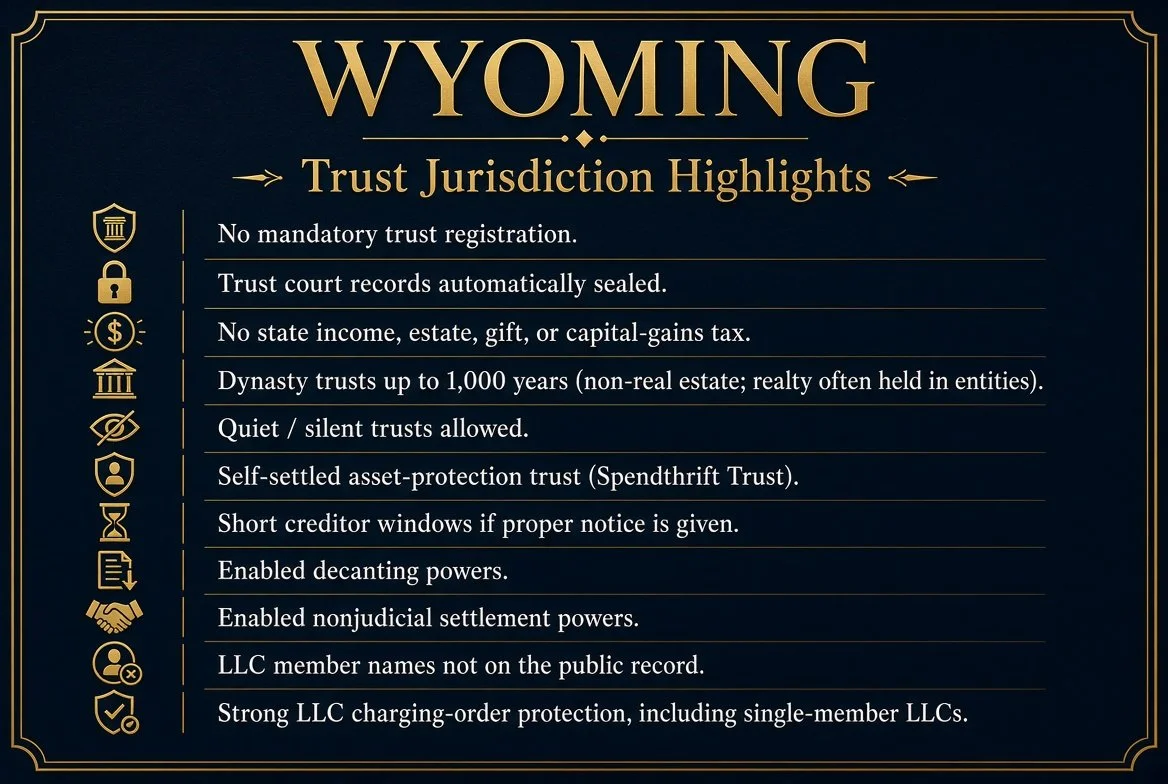
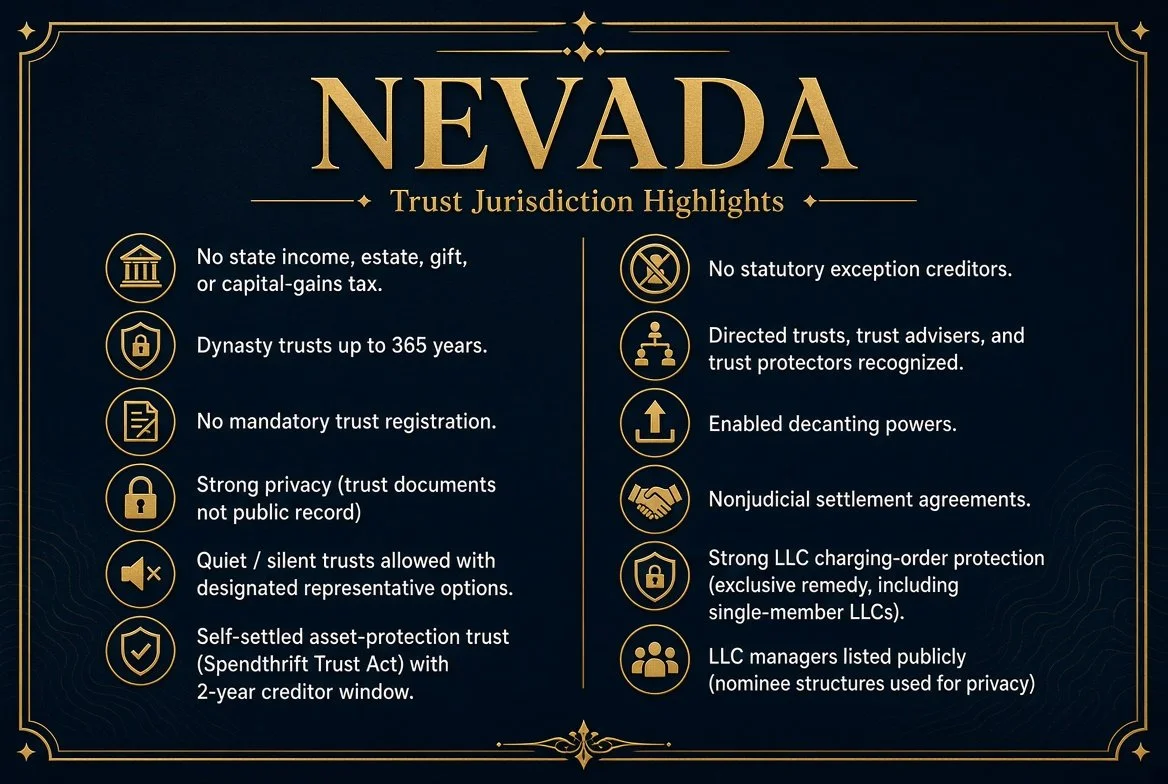
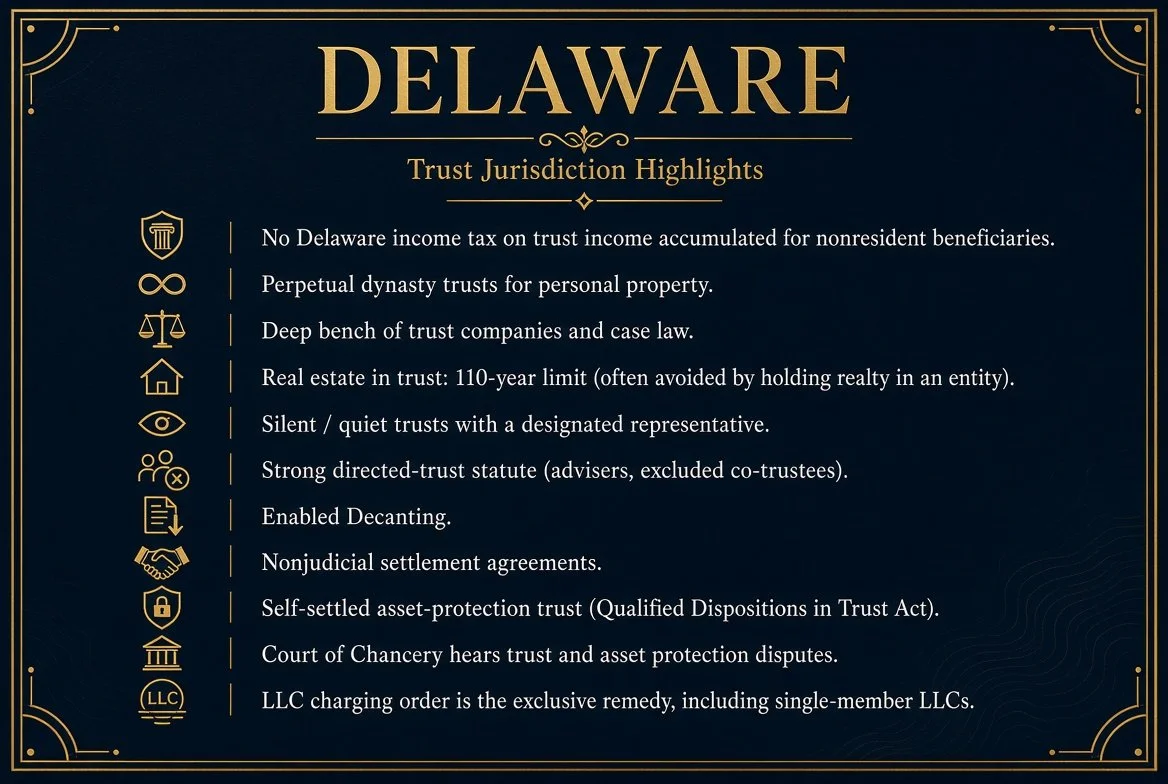
Here are the sources behind the bullet points in the state specific graphics above:
Wyoming
Wyoming’s trust rules live mainly in Wyoming’s Uniform Trust Code Title 4, Chapter 10. Court records in trust cases are automatically sealed (W.S. § 4-10-205).
Discretionary trusts and spendthrift protection run through W.S. §§ 4-10-501 through 4-10-509, especially §§ 4-10-504 and 4-10-506.
Self-settled asset protection is the Qualified Spendthrift Trust in W.S. §§ 4-10-510 through 4-10-523, with child-support and other exception creditors addressed in § 4-10-520.
Directed trusts are defined in § 4-10-103(a)(xxviii), with advisors and protectors treated in §§ 4-10-710, 4-10-712, and 4-10-718;
trust protectors and trust advisors also appear in § 4-10-103(a)(xxii)–(xxiii) and those same 710/712 provisions.
Decanting—distributing in further trust—is in § 4-10-816(a)(xxviii).
Interested persons can use a UTC-style nonjudicial settlement under § 4-10-111.
Equity is not displaced: § 4-10-106 says the common law of trusts and principles of equity supplement the act.
There is no public registration requirement in the Uniform Trust Code.
No state income tax is Wyoming Constitution, Article 15, § 18.
The 1,000-year dynasty term is W.S. § 34-1-139 (property / perpetuities), not Chapter 10.
The creditor 120-day notice shortcut for qualified transfers is mainly W.S. § 34-14-210 (fraudulent transfers), working together with Article 5.
LLC charging-order protection and the fact that member names are not public live in the Wyoming LLC statutes (Title 17), not the Trust Code.
Private and family trust companies, and what they cost, are banking and trust-company regulation under Title 13, plus market practice—not the UTC.
Quiet or silent trusts are possible because the terms of the instrument generally prevail except where the Code locks in a mandatory rule; the duty to inform is not frozen the way it often is in the model Uniform Trust Code (W.S. § 4-10-105).
Nevada
Nevada’s primary trust statutes are in the Nevada Revised Statutes (NRS), mainly Chapter 163 (Trusts) and Chapter 166 (Spendthrift Trusts). Nevada has not adopted the Uniform Trust Code. Chapter 163 contains the general trust framework (sometimes called the Uniform Trusts Act for certain sections), while Chapter 166 specifically authorizes self-settled spendthrift trusts.
No state income tax on trusts (or individuals) follows from Nevada’s constitutional and statutory structure; there is no Nevada income tax, estate tax, or gift tax.
Dynasty trusts lasting up to 365 years are permitted under NRS 111.1031 (Statutory Rule Against Perpetuities). A nonvested property interest is valid if it vests or terminates within 365 years after its creation.
There is no public registration requirement for trusts under NRS Chapters 163 or 164. Trust instruments are not filed with any state agency in the ordinary course of administration.
Quiet or silent trusts are possible because the terms of the instrument generally control the trustee’s duties to inform and report to beneficiaries, subject to any mandatory rules. Designated representatives can be used to receive information on behalf of beneficiaries during periods of limited disclosure.
Self-settled asset protection is authorized by the Spendthrift Trust Act in NRS Chapter 166 (especially NRS 166.040). When the settlor is a beneficiary, at least one trustee must be a Nevada resident or Nevada trust company, and the trust must be irrevocable with discretionary (not mandatory) distributions to the settlor. Creditor challenge periods are set by NRS 166.170: generally two years after the transfer, or six months after discovery for a pre-existing creditor (whichever is later). Nevada’s statute lists no exception creditors.
Directed trusts, trust advisers, and trust protectors are recognized in the Directed Trusts subchapter of NRS Chapter 163 (NRS 163.553 et seq.). This includes investment trust advisers, distribution trust advisers, and trust protectors, with limitations on the liability of a directed fiduciary (NRS 163.5549).
Decanting—distributing in further trust—is authorized by NRS 163.556. A trustee with discretionary authority to distribute income or principal may appoint the property to a second irrevocable trust, unless the instrument provides otherwise.
Nonjudicial settlement agreements and related non-judicial modifications are available under the trust administration provisions of NRS Chapters 163 and 164.
LLC charging-order protection, including for single-member LLCs, is in the Nevada Limited-Liability Company Act at NRS 86.401. The charging order is the exclusive remedy; foreclosure and other remedies are unavailable whether the LLC has one member or more than one member.
LLC managers (or managing members) are listed on the Initial List and Annual List filed with the Secretary of State (NRS 86.263). Nominee or manager-managed structures are commonly used to limit public disclosure of beneficial owners.
Delaware
Delaware’s core trust statutes are in Title 12 of the Delaware Code, primarily Chapter 33 (Trust Act) and Chapter 35 (including the Qualified Dispositions in Trust Act). Delaware has not adopted the Uniform Trust Code.
No Delaware income tax on trust income accumulated for nonresident beneficiaries is 30 Del. C. § 1636 (nonresident beneficiary deduction for resident estates or trusts).
Perpetual dynasty trusts for personal property and the 110-year limit for real estate held directly in trust are in 25 Del. C. § 503. Interests in entities (LLCs, corporations, partnerships, etc.) that own real estate are treated as personal property, so the 110-year limit is commonly avoided that way.
Silent / quiet trusts with a designated representative are enabled by 12 Del. C. § 3303 (especially subsections allowing the instrument to restrict or eliminate a beneficiary’s right to information for a period of time) and 12 Del. C. § 3339 (designated representative who represents and binds the beneficiary during that period).
Strong directed-trust statute (advisers, excluded co-trustees) is 12 Del. C. § 3313 (advisers who may direct, consent to, or disapprove investment, distribution, or other decisions; directed fiduciary generally liable only for willful misconduct) and related provisions including § 3313A (excluded co-trustees).
Enabled Decanting is 12 Del. C. § 3528 (trustee with authority to distribute principal or income may appoint in further trust, unless the instrument expressly provides otherwise).
Nonjudicial settlement agreements are authorized by 12 Del. C. § 3338 (interested persons may enter a binding nonjudicial settlement agreement as to any matter involving a trust, subject to material-purpose and other limits).
Self-settled asset-protection trust (Qualified Dispositions in Trust Act) is 12 Del. C. §§ 3570–3576. A “qualified disposition” requires a Delaware-qualified trustee and an irrevocable trust with a spendthrift provision. Creditor challenge periods and exception creditors (including certain support/alimony and pre-transfer tort claims) are addressed in §§ 3572 and 3573.
Court of Chancery hears trust and asset protection disputes follows from the court’s general equity jurisdiction (10 Del. C. § 341) and the exclusive jurisdiction provisions in the Qualified Dispositions in Trust Act (12 Del. C. § 3572).
LLC charging order is the exclusive remedy, including single-member LLCs is 6 Del. C. § 18-703 (charging order is the exclusive remedy; attachment, garnishment, foreclosure, and other remedies are unavailable whether the LLC has one member or more than one member; creditors have no right to LLC property).
Deep bench of trust companies and case law reflects Delaware’s long-standing institutional trustee industry and the extensive body of Court of Chancery decisions interpreting Title 12 and related statutes.